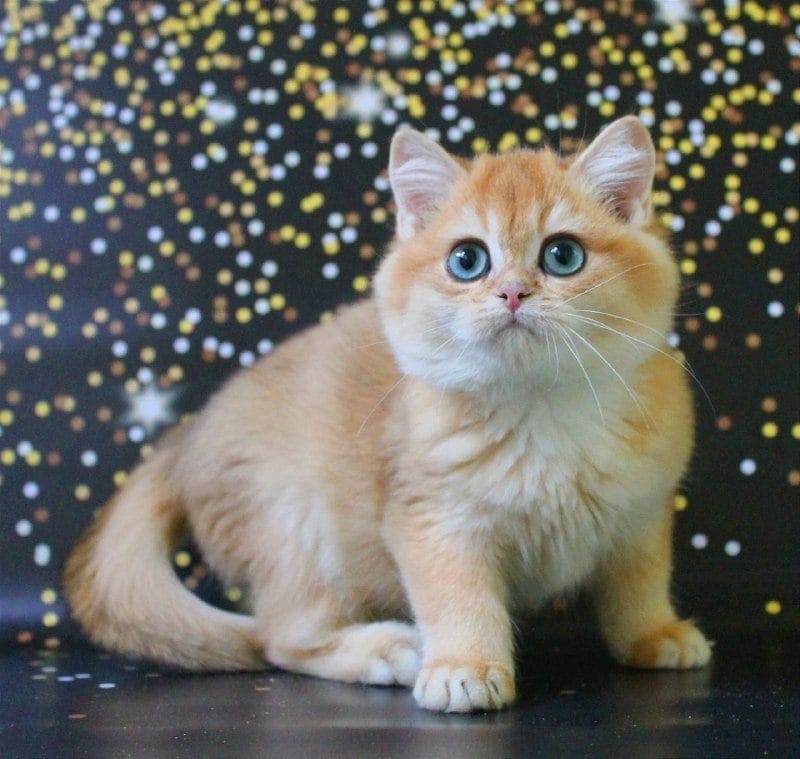

A Maine Coon and dog can often live comfortably together, but their individual temperaments, past experiences and introduction matter more than breed alone. Some become playmates; peaceful coexistence without a close friendship is a successful outcome, too.
Do Maine Coon cats get along with dogs?
Many Maine Coons are friendly with dogs and can share a home with them when both animals feel safe. A cat that enjoys people is not automatically comfortable with dogs, however, and a dog’s previous behavior around cats deserves close attention.
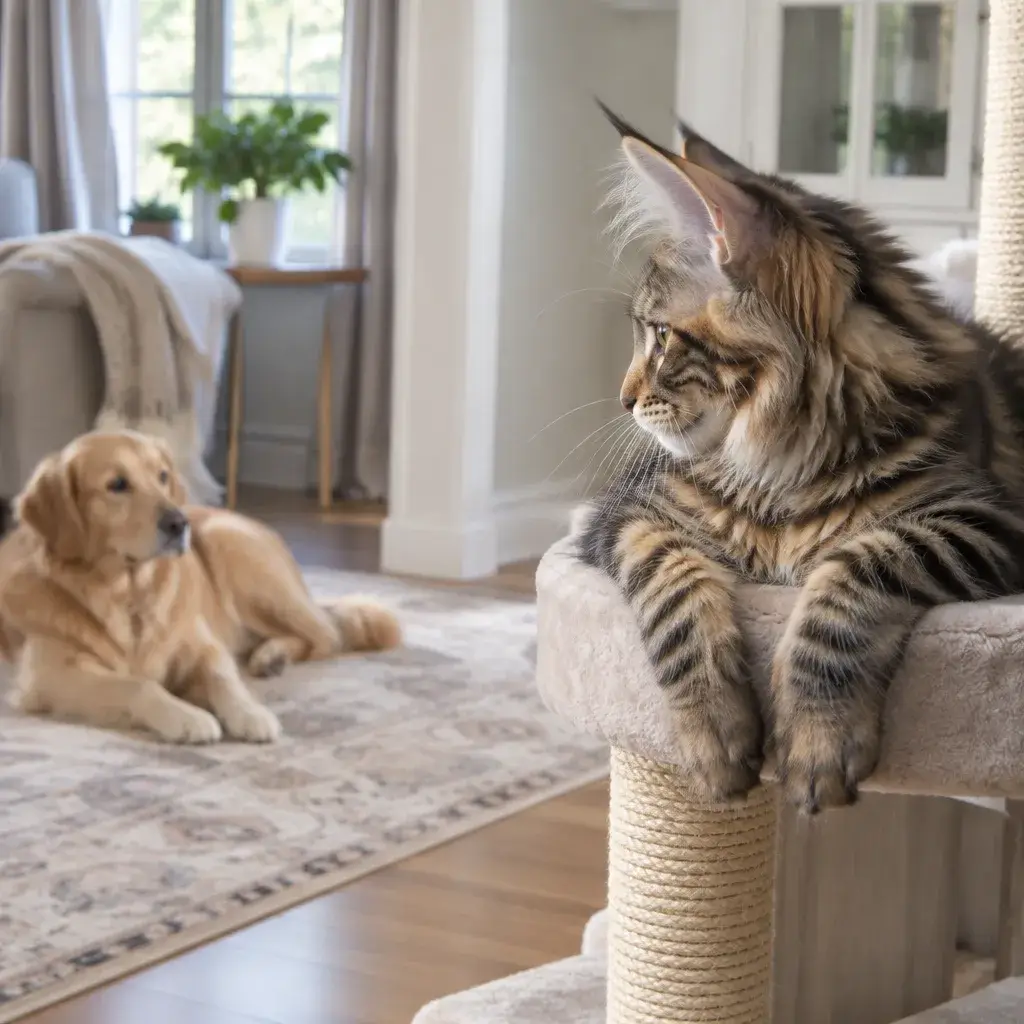
Maine Coons can protect their space and resources, just like other cats. If you are considering a kitten, ask about its individual temperament and any known experience with dogs rather than assuming the breed will be a perfect match.
When families ask us about a Maine Coon for sale, my advice is to consider the household as a whole: the resident dog’s behavior, the space available for separation and the time you can devote to introductions. A kitten needs an escape plan even if your dog is normally gentle.
Are Maine Coons like dogs?
Some Maine Coons seem dog-like because they follow their people, enjoy interactive play or even learn to fetch. Others prefer to watch from a comfortable distance or play on their own terms.
These are still cats with feline needs for choice, rest, scratching and safe places. A Maine Coon that follows you from room to room may still find a dog’s barking or enthusiastic greeting unsettling. Let the cat decide how close to get rather than expecting it to behave like a canine companion.

Which dogs are a good match for a Maine Coon?
A calm, responsive dog with a positive history around cats is generally a better candidate than a dog chosen by breed name alone. Look for a dog that can notice a cat, respond to its person and turn away without lunging or chasing.
A Golden Retriever or Labrador Retriever may be a good fit, but an excitable individual can still frighten or injure a cat. A Greyhound, terrier or hound may have a strong interest in chasing small animals, but behavior and history vary from dog to dog. Ask about past interactions and assess the individual rather than assuming a breed is safe or unsafe.
A Maine Coon and German Shepherd can live together, but pay particular attention to the dog’s size, arousal and ability to disengage. If a dog has attacked a cat, repeatedly fixates on one or cannot be redirected at a distance, keep the animals separated and consult your veterinarian and a qualified behavior professional before attempting an introduction. Some pairings may require permanent separation.

How do you introduce a Maine Coon and a dog?
Introduce them gradually, beginning with separation and progressing only when both animals remain comfortable. Allow days or longer for each stage if needed; there is no deadline that makes an animal ready.

- Start in separate areas. Let the newcomer settle without a face-to-face meeting. Keep doors secure and make sure each pet can eat, rest and use its usual toilet area without being approached.
- Exchange scents. Swap bedding or gently place an item that smells of each pet near the other’s area. Let each animal investigate or walk away; do not hold the item against its face.
- Arrange controlled visual contact. Use a secure barrier that prevents either animal from reaching or squeezing through it. Begin far enough away that both can notice the other without becoming tense. Reward the dog for calm attention and looking away; offer the cat a treat if it is comfortable eating.
- Try brief supervised meetings. Once barrier sessions are consistently calm, use a leash and well-fitted harness for the dog, with an adult holding the leash. Let the cat move freely and retreat to a dog-free room or an elevated route. Keep the meeting short and end while both are calm.
- Build gradually. Repeat calm sessions and increase time only as both pets cope well. If either becomes distressed or the dog fixates, increase distance, end the session and return to the last comfortable step.
Do not hold the cat in front of the dog or allow the dog to chase, even in play. For help with the broader settling-in routine, see our first week with a new kitten guide.
Should the newcomer stay in an enclosed space?
Yes. A secure, comfortable separate room or suitable area gives the newcomer time to settle and prevents an uncontrolled first meeting.
For a new cat, provide a litter box, food and water in separate spots, bedding, hiding places and a scratching surface. For a new dog, set up a separate area with water, a resting place and appropriate opportunities for exercise and bathroom breaks. A kitten should not be confined in a box for an introduction, and neither resident pet should be forced to approach the closed door or barrier.
How do you protect the established pet’s favorite spaces?
Keep the resident pet’s familiar resting places and routines accessible, and prevent the newcomer from taking them over. Use closed doors or secure barriers to protect those areas while the animals adjust.
Give the cat dog-free retreats and sturdy elevated routes that do not lead to a dead end. A resident dog should also have a quiet place where the cat cannot disturb it, particularly when the dog is sleeping or eating.
What should you watch for when a Maine Coon is beside a dog?
Look for relaxed bodies and the ability to notice each other and then disengage. Staring, stalking, chasing, hiding, flattened ears or growling are reasons to add distance and reassess.
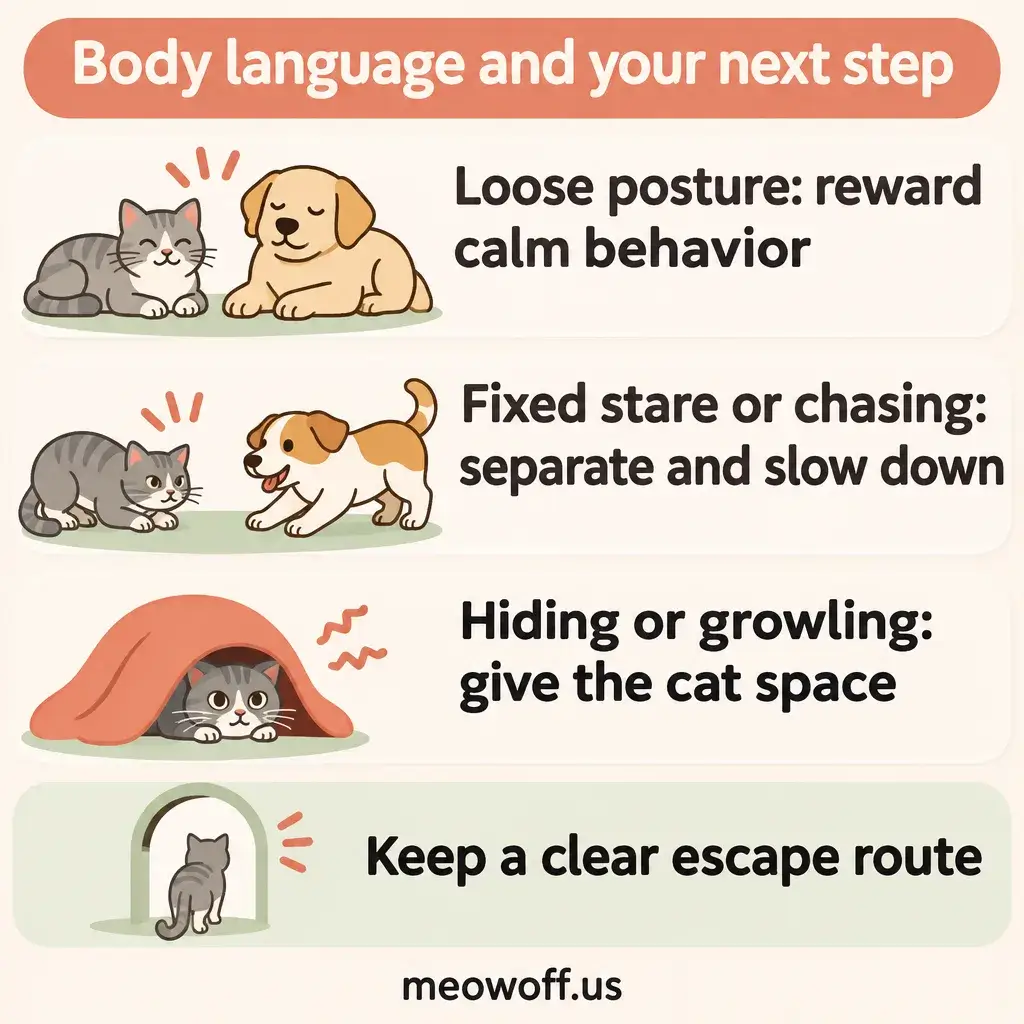
| What you notice | What to do |
|---|---|
| Loose posture; the dog responds to you; the cat explores or walks away | Reward calm behavior and keep the session brief. |
| Fixed stare, stiff body, stalking, lunging or chasing | End the encounter safely, separate the pets and return to an easier stage. |
| Cat hides, flattens its ears, growls or cannot retreat | Give the cat space and a clear escape route; slow the introduction. |
A wagging tail alone does not prove a dog is relaxed, and a quiet cat is not necessarily comfortable. Watch the whole animal and whether it can move away. Interrupt early by calmly calling the dog away or using a barrier; do not punish growling or force contact.
Do not leave the pets alone together until their interactions have been reliably safe under supervision. Even then, use separate areas when you cannot confidently manage the risk; if fixation, chasing or conflict persists, maintain separation and seek professional help.
Can a Maine Coon hurt or kill a dog, or defend itself?
A Maine Coon can scratch or bite a dog, including injuring an eye, and a serious fight can hurt either animal. A cat killing a dog would be highly unusual, but a bite or scratch can still cause serious harm and needs attention.
A Maine Coon’s size and sturdy build do not make play with a dog automatically safe. Do not count on a cat to defend itself or assume a small dog cannot hurt a kitten. Prevention, escape routes and supervision are safer than letting the animals work out a dispute.
If a fight starts, do not put your hands between the animals or grab their collars near their mouths. If you can do so safely, use a solid barrier such as a closed door or large piece of cardboard to separate them, then secure each pet in a different room. Do not put yourself in danger; get help if you cannot separate them safely.
Call a veterinarian promptly after a bite, scratch, eye injury or other wound, even if it looks small. An injured or squinting eye, severe bleeding, trouble breathing, collapse or inability to stand warrants emergency veterinary care. Do not give human pain medicine or put products in an injured eye unless a veterinarian directs you to do so.
How do you keep both pets comfortable at home?
Give each pet secure access to food, rest, play and attention without competition. Equal minutes of attention are not necessary; meeting each animal’s needs and maintaining familiar routines matters more.
- Feed separately. Use different rooms or a secure barrier, and pick up leftovers before allowing access to the feeding areas.
- Protect litter access. Place the cat’s litter box where the dog cannot enter but the cat can reach it easily. Avoid a location where the dog can wait and block the cat’s exit.
- Provide separate rest and play. Give each pet a quiet sleeping area and individual playtime. Keep prized toys and treats separate if either animal guards them.
- Keep training gentle and consistent. Practice the dog’s response to cues such as “come” and “leave it” away from the cat first, then reward calm choices during controlled sessions.
Call your veterinarian if either pet persistently hides, eats less, changes its bathroom habits or shows other signs of stress. Seek emergency care for difficulty breathing, collapse, inability to urinate, or a cat repeatedly straining to urinate with little or no urine produced. For ongoing tension or aggression, ask your veterinarian for a referral to a qualified behavior professional.

If you are looking at Maine Coon kittens for sale in New Jersey, plan the separate settling-in room before your kitten arrives. At MeoWoff, kittens go home at 12–16 weeks, after socialization and age-appropriate vaccines, and we share veterinary records and guidance for the first 48 hours and weeks at home.
Questions about Maine Coons and dogs? Talk to MeoWoff
We can discuss choosing a kitten for a home with a dog and preparing a safe introduction for the first weeks together.
Call (773) 917-0073 or send us a message to talk with our team.