

Female Munchkin cats typically weigh 5–9 pounds as adults. Their short legs make them lower to the ground, but their bodies grow to adult size rather than remaining kitten-sized.
Individual size depends on parentage, nutrition and health. If you are considering one of our Munchkin kittens, use these ranges as a starting point, not a promise about an individual kitten.
How big does a female Munchkin get?
A female Munchkin is generally a small-to-medium cat weighing about 5–9 pounds when fully grown. She has a relatively low stance because of her short legs, while her torso is not necessarily much smaller than that of another domestic cat.
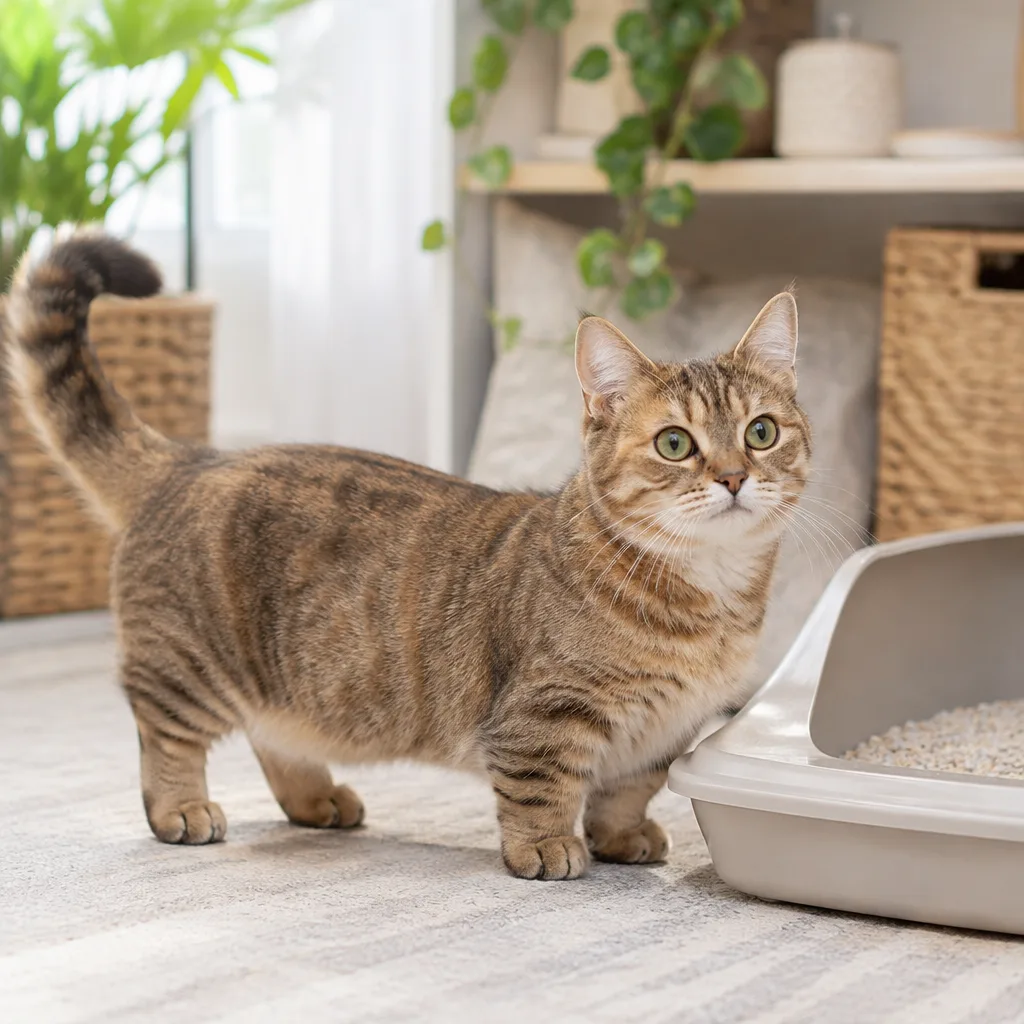
There is no dependable single female-specific height to expect: leg length and body build vary. When comparing cats, measure from the floor to the top of the shoulder while the cat is standing naturally, and remember that height alone does not tell you whether she is at a healthy weight.
Some kittens from Munchkin breeding programs have longer legs, so ask about the individual kitten rather than assuming every cat will have the same proportions. A small frame is not a reason to expect an adult to fit into kitten-sized equipment forever.
How does her size compare with a male’s?
Male Munchkins typically weigh about 6–10 pounds, compared with 5–9 pounds for females. The ranges overlap, so a particular female can be larger than a particular male.
| Adult cat | Typical weight | What to remember |
|---|---|---|
| Female Munchkin | 5–9 pounds | Individual frame and body condition vary. |
| Male Munchkin | 6–10 pounds | Some males are smaller than some females. |
A cat at either end of a range is not automatically underweight or overweight. Your veterinarian can assess her body condition, muscle and weight history alongside the number on the scale.
When does a female Munchkin stop growing?
Most of a female Munchkin’s growth happens during her first year, although she may continue to fill out afterward. Timing varies, so follow her individual growth trend instead of expecting a particular weight at every birthday or month.
For more on what to expect when a Munchkin kitten is full grown, see our discussion of adult size and health.
Do female Munchkins stay small?
A short-legged female keeps her short legs, but her body grows into an adult cat. She is not a kitten forever, and her adult weight may overlap with that of other domestic cats.
Our guide to whether a cat stays small explains the difference between low stature and overall adult size.
What affects her adult size and growth?
Parentage, leg length, nutrition and health all contribute to a female Munchkin’s appearance and growth. Her parents can offer clues about her eventual build, but they cannot predict her exact adult weight.
Ask how much each parent weighs, whether their body condition is healthy and whether you can see them or review recent information about them. A larger-framed parent may produce a larger-framed kitten, although kittens in the same litter can differ.
The short-legged appearance is a genetic skeletal variation, not simply the result of being a small cat. Leg length can vary, and a lower cat is not necessarily lighter or healthier; learn more about why Munchkin cats are so short and the wider subject of cats with dwarfism.
Feed a complete and balanced food labeled for kitten growth, using the package directions as an initial guide and adjusting with your veterinarian. Provide fresh water, measure meals and account for treats; do not add vitamins, minerals or joint supplements unless your vet recommends them.
For example, if a kitten is gaining steadily but seems smaller than a littermate, bring both her weight record and feeding details to her next appointment rather than trying to make her match the other kitten. If her growth stalls or she loses weight, call your veterinarian promptly; a kitten who is weak, collapses or has trouble breathing needs emergency care.
Illness, parasites or inadequate food intake can interfere with growth, so a sudden change deserves attention rather than a larger portion chosen at random. Your vet can examine her and decide whether a diet change or testing is needed.

How can you monitor her weight and movement?
Record your kitten’s weight regularly and ask your veterinarian to assess her body condition and movement at checkups. A consistent trend and comfortable movement are more useful than comparing her with a rigid breed-specific kitten weight chart.
Use a scale that can measure small changes, weigh her at roughly the same time of day and write down the date and result. A carrier or container on the scale can help: weigh it empty first, then subtract that weight from the combined reading. For a growing kitten, a weekly record gives you useful information to share with your vet.
Body condition is more than a number. Your vet can show you how to feel for ribs beneath a light covering and assess her waist without mistaking her short legs or natural body shape for excess weight. Do not put a growing kitten on a weight-loss diet without veterinary guidance.
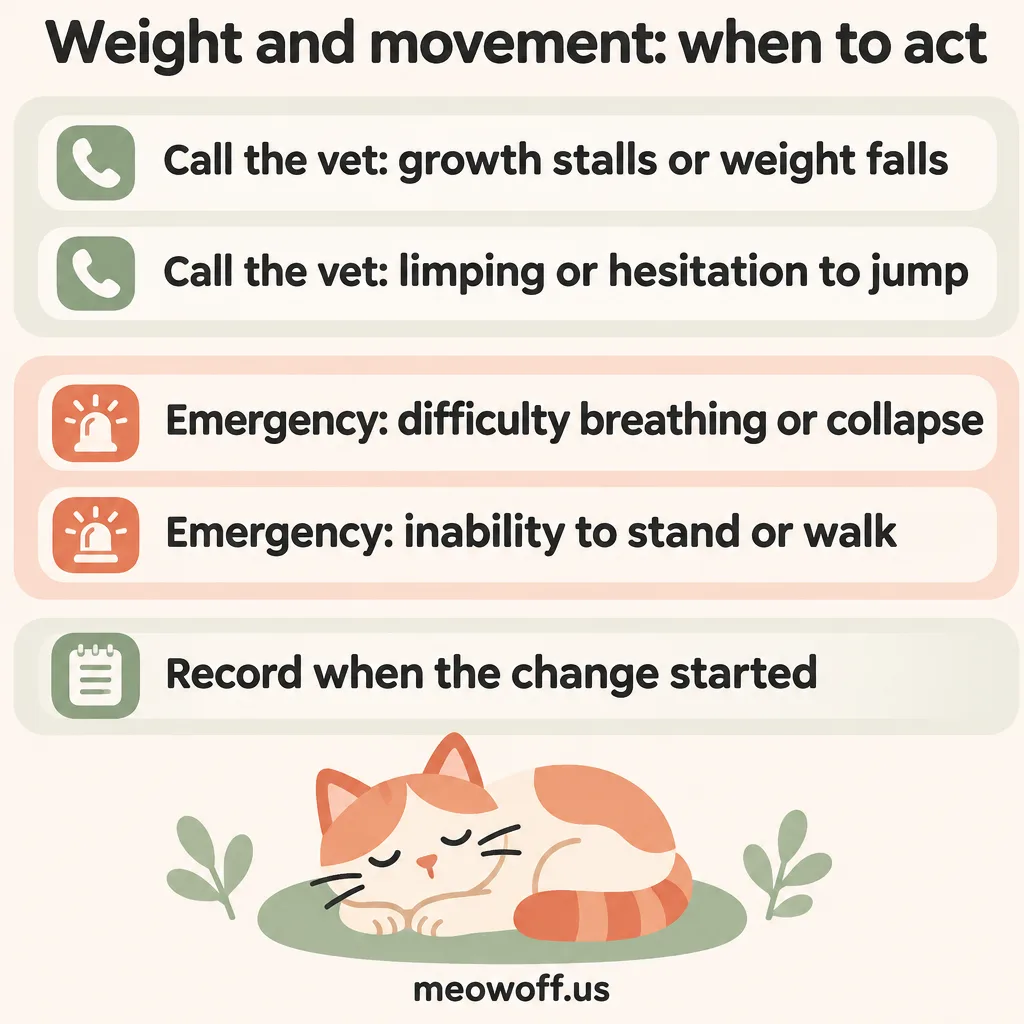
- Call your veterinarian promptly if growth stalls, weight falls, appetite changes, or your cat begins limping or hesitating to jump.
- Seek emergency care for difficulty breathing, collapse, inability to stand or walk, severe pain, or sudden hind-leg weakness or paralysis.
- Share the details: note when a change started, which activities are affected and whether it is getting worse. A short video of her usual movement can help your vet.
Short legs may change how a Munchkin reaches a favorite spot, but reluctance to move is not something to dismiss as normal for the breed. Call your vet if you notice a new limp, stiffness, a hunched posture or avoidance of handling; severe pain or inability to walk calls for emergency care.
Lordosis means an excessive curvature of the spine and can occur in cats; a breed-specific increase in risk has not been clearly established. If you notice an unusual posture or a change in mobility, ask your veterinarian to examine her; breathing difficulty is an emergency regardless of the cause.
At home, choose a low-entry litter box large enough for her to turn around comfortably, and place sturdy steps or a ramp near a favorite resting spot. Keep food and water easy to reach, offer low scratchers and supervised play, and avoid forcing her to jump or exercise if she seems uncomfortable.
Some cats need help grooming areas they cannot reach comfortably. Brush regularly, check for mats and ask your vet about grooming or nail-trimming difficulties rather than assuming that all short-legged cats have the same limitations.

What should you check before choosing a female kitten?
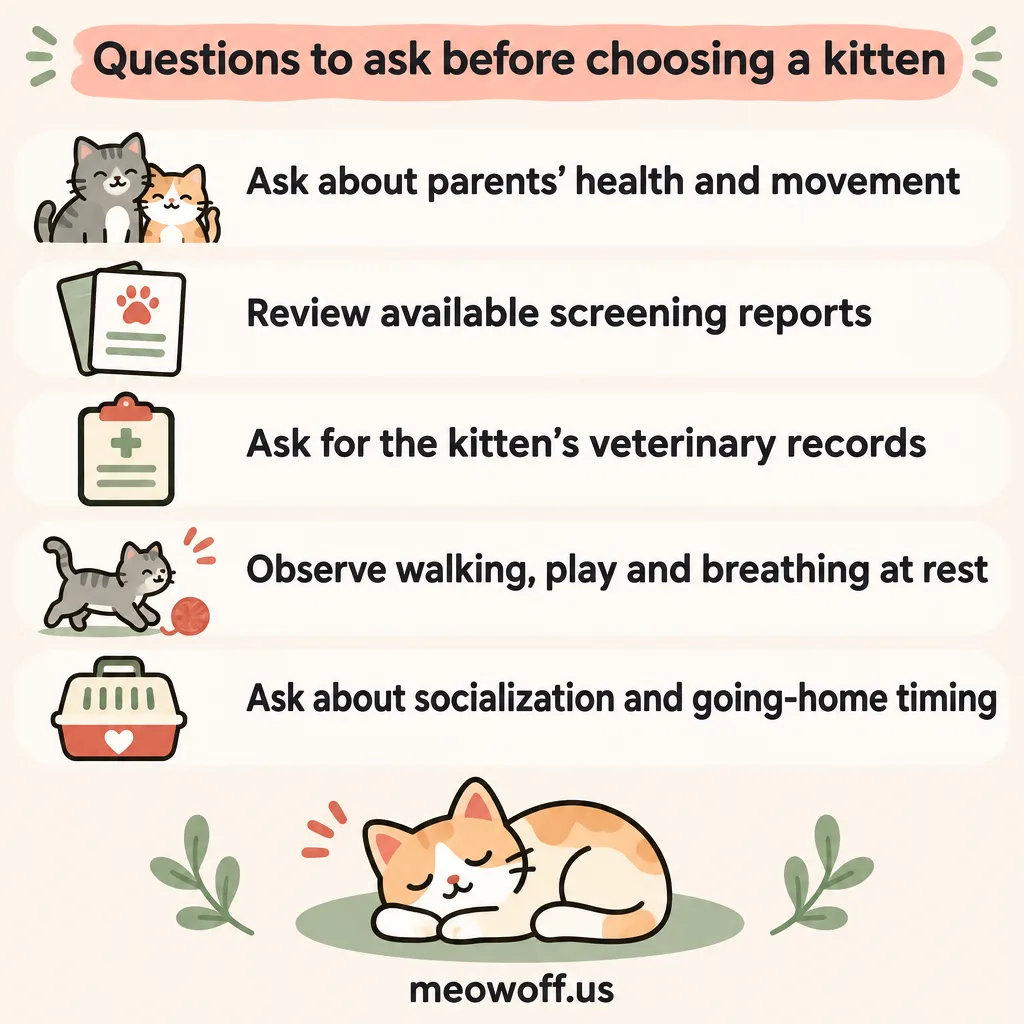
Check the kitten’s health records, parentage, socialization and comfortable movement before making a decision. Ask questions about both parents and observe the kitten walking, playing and breathing at rest rather than choosing solely for the shortest legs.
My priority is health, genetics and temperament before looks. A confident, curious kitten may still need time to settle in a new place, and a quiet kitten is not necessarily unwell; ask how she behaves in her familiar environment and how she has been introduced to everyday handling and sounds.
- Parents: What are their approximate sizes, health histories and usual movement like? Are there known inherited conditions or mobility concerns in the family?
- Screening: What examinations or genetic tests have the parents had, and what did the results show? Ask to review available reports and discuss what each test can and cannot tell you.
- Kitten records: What has a veterinarian examined, and which vaccines and other care has she received? Ask for the records and the schedule your own vet should review.
- Daily behavior: Can she walk and play comfortably, reach food and water, and use a litter box? How does she respond to gentle handling and normal household activity?
- Going home: When will she be ready, what food is she eating, and what guidance is available for the transition?
Call a veterinarian if a kitten has a limp, persistent eye or nasal discharge, poor appetite or an apparent change in activity. Difficulty breathing, collapse or inability to walk requires emergency veterinary care; do not rely on an appearance-based assessment to diagnose the cause.
TICA or WCF registration provides information about a cattery’s registration, but registration alone is not a guarantee of health. Ask to see records and discuss any concerns with your own veterinarian before committing.
At MeoWoff, kittens go home at 12–16 weeks, after socialization and age-appropriate vaccines. They are microchipped, their vet records are shared with the family, and we provide guidance for the first 48 hours and first weeks at home.
Our typical kitten prices are $2,100–$5,800, depending on breed, pedigree and quality. A $500 deposit reserves a kitten and is part of the price; ask about the individual kitten’s price and what is included before paying.
| Planning item | MeoWoff price or arrangement |
|---|---|
| Kitten | Typically $2,100–$5,800 |
| Reservation deposit | $500, included in the kitten price |
| Wood Dale pickup | Available by arrangement |
| Ground delivery | From $600 |
| Flight nanny delivery | From $1,000 |
| Optional heart ultrasound or genetic test | $200 each |
Plan separately for food, a carrier, litter, routine veterinary care and unexpected medical expenses; those costs depend on your location and the care your cat needs. Ask what an optional test checks and discuss its usefulness with your veterinarian rather than treating any single result as a guarantee.
Our showroom at 126 E Irving Park Rd, Wood Dale, IL 60191, is open for visits by appointment. We offer pickup and delivery to all 50 states; confirm the arrangements and total cost for your location before reserving.
If you are still comparing breeds, browse our purebred kittens for sale. Families considering another breed and location can also explore British kittens in Hawaii; ask the same questions about health records, temperament and delivery.
For more background on personality and everyday care, read our introduction to the Munchkin cat breed. Whatever breed you choose, arrange an initial visit with your own veterinarian and bring the records you receive so you can make a care plan together.
Questions about female Munchkin size? Talk to MeoWoff
We can help you discuss a kitten’s expected size, review the information available and prepare for her first weeks at home.
Call (773) 917-0073 or send us a message to talk with our team.


