

Months two and three at home: what to expect from your kitten after the initial adjustment depends first on how old your kitten was when they arrived. Expect more confident exploration, energetic play and new care questions, but keep watching for changes that may need a veterinarian’s attention.
These months are not necessarily your kitten’s second and third months of life. Below, I’ll cover both meanings, from the needs of an eight-week-old kitten to the growing independence of a kitten who has already spent several weeks with your family.
Months two and three at home: what age is your kitten?
Months two and three at home are the second and third months after your kitten arrives, not the kitten’s age in months. A kitten who comes home at 12–16 weeks will be roughly four to seven months old during that period.
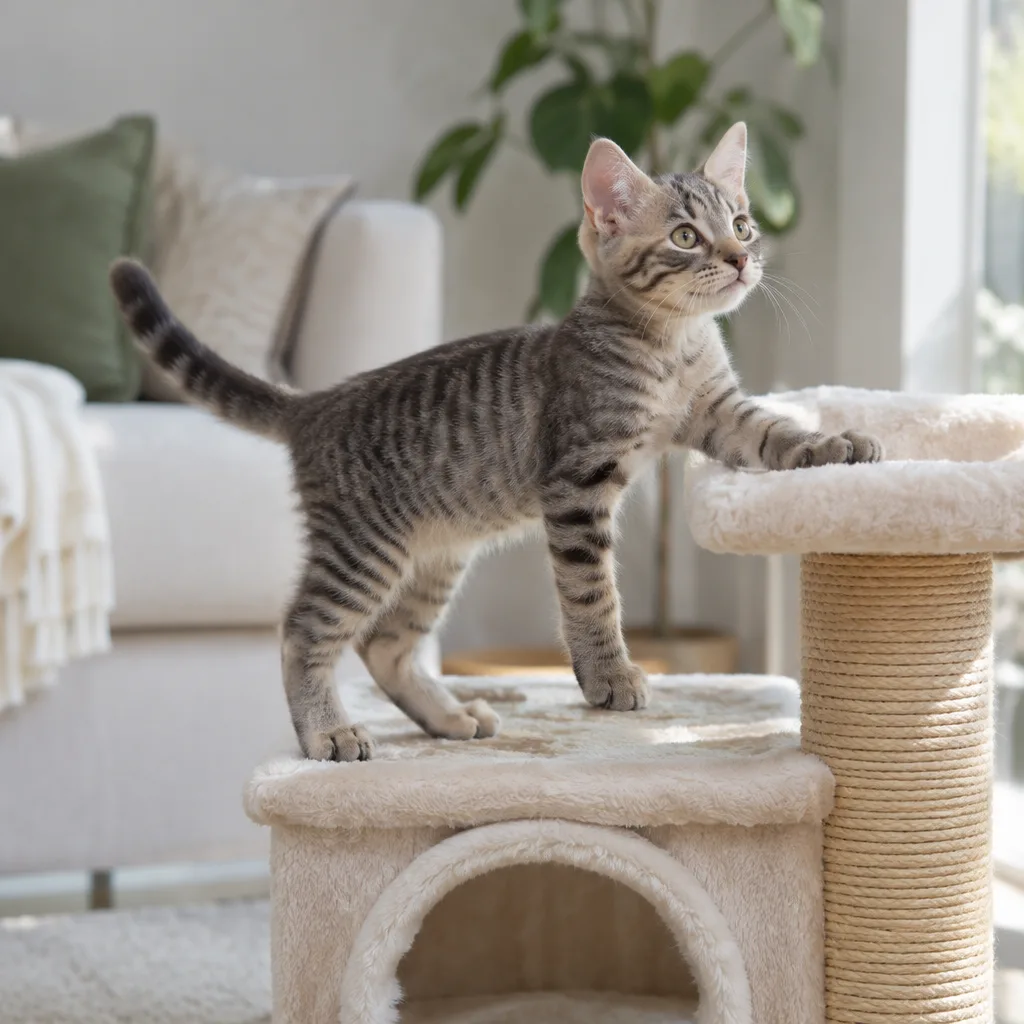
For example, a kitten who arrives at 12 weeks will be about four months old at the beginning of their second month home and about six months old near the end of their third. A kitten arriving at 16 weeks will be older at those same points.
MeoWoff kittens go home at 12–16 weeks, after socialization and age-appropriate vaccines. If your kitten has just arrived, our guide to the first week with a new kitten can help you establish a starting routine before the more adventurous weeks ahead.
What should a two- or three-month-old kitten be doing?
At two to three months old, most kittens are learning through play, exploring their surroundings, interacting with people and using a litter box. Their coordination and confidence grow quickly, although their personalities and development vary.
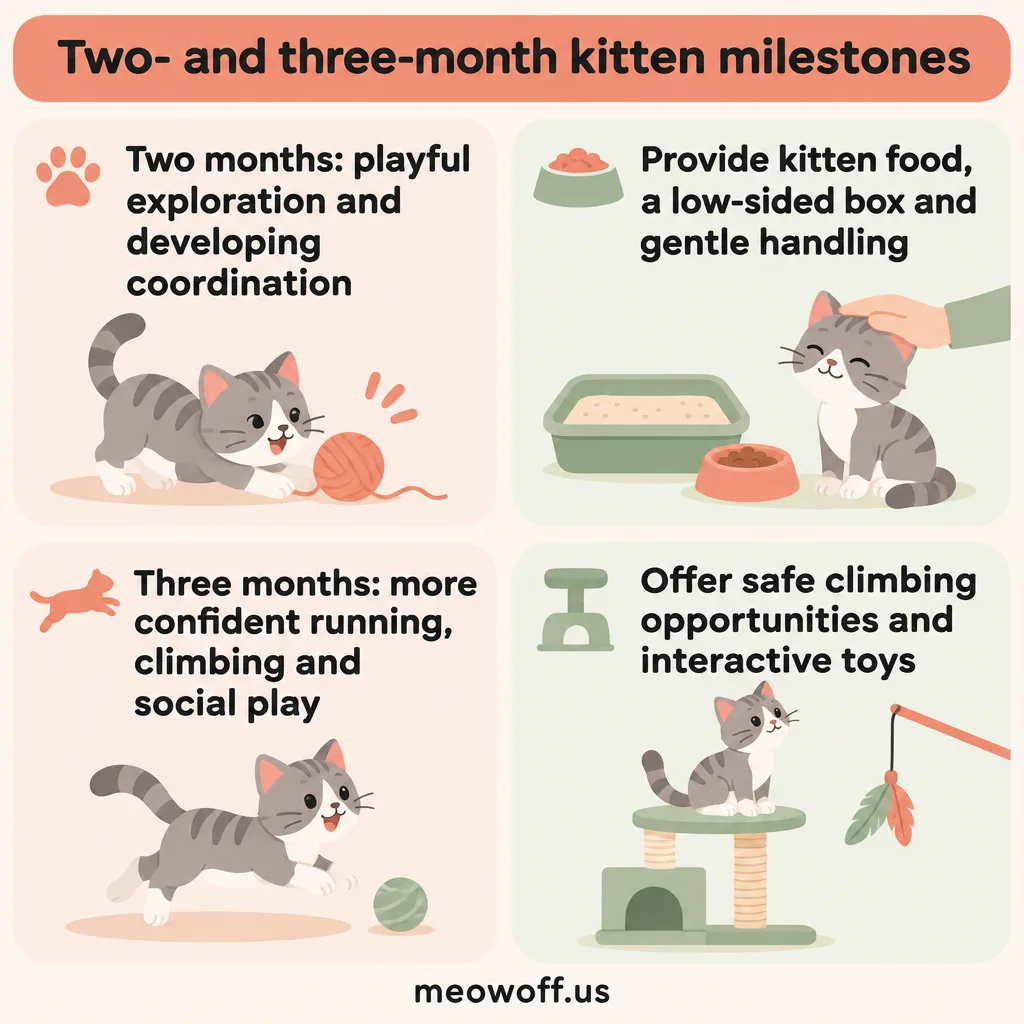
| Age | Typical development | How to help |
|---|---|---|
| About two months | Playful exploration, developing coordination and litter-box habits | Provide kitten food, a low-sided box, gentle handling and close supervision |
| About three months | More confident running, climbing and social play | Offer safe climbing opportunities, interactive toys and a consistent routine |
A three-month-old kitten may stalk a toy, groom themselves and seek attention, then disappear for a nap. Some are outgoing and others prefer to observe first; neither personality alone tells you whether a kitten is healthy.
If you are considering a younger kitten, ask the breeder when the kitten will be ready to leave, what food they eat independently and which veterinary records will be shared. My priority is health, genetics and temperament, not an early pickup. MeoWoff does not release kittens before they are developmentally ready.
How big is a three-month-old kitten?
A three-month-old kitten often weighs roughly 2.5–4 pounds; at two months, a common range is about 1.5–2.5 pounds. Breed, body frame and individual growth all affect size, so a number outside these ranges does not automatically mean something is wrong.
Weigh your kitten regularly on the same scale, ideally at a similar time of day, and write down the result. A kitchen or baby scale can work if the kitten can sit safely in a secure container; subtract the container’s weight.
Ask your veterinarian about weight loss, poor gain or a kitten who feels unusually thin. For example, if a three-month-old’s weight has stalled and they are eating less, call rather than simply increasing food and waiting. A weak, collapsed or unresponsive kitten needs emergency care.
What changes during months two and three at home?
During the second and third months after arrival, many kittens become stronger, climb higher and show more of their individual play style. Some also seek more independence, while others remain close companions throughout the day.
| Time at home | What you might notice | Practical response |
|---|---|---|
| Second month | More exploration and confidence with familiar rooms | Recheck cords, small objects and access to unsafe spaces |
| Third month | Stronger jumps, energetic play or changing preferences for attention | Add stable climbing space and keep play and rest predictable |
These are possibilities, not deadlines. Growth varies by age and breed, and a kitten will not necessarily double in size during these months. A shy kitten may need more time, and a once-cuddly kitten may prefer sitting nearby rather than on your lap.
Secure tall furniture and choose a stable cat tree or low perch. Keep string, hair ties and wand toys out of reach when you cannot supervise; a swallowed object can cause a dangerous blockage.
Families browsing Scottish Fold kittens for sale in Connecticut, for example, should plan for these changing abilities as well as the kitten’s first days home. Individual needs and veterinary guidance matter more than choosing for appearance alone.
Is biting, chewing or distance normal?
Play biting, some chewing and changes in how much attention a kitten wants can be normal, but pain or a sudden behavior change deserves attention. Adult teeth typically emerge between about three and six months, and curious kittens may investigate objects with their mouths.
Use a wand or other suitable toy instead of hands and feet. If teeth touch skin during play, pause the game, then reward calm behavior and offer a toy when your kitten is ready. Avoid punishment; it can make a kitten fearful without teaching an alternative.
Offer kitten-appropriate toys that cannot be easily broken or swallowed, and cover or remove electrical cords. For more ways to encourage good habits, see our kitten training recommendations.
Call your veterinarian for drooling, dropping food, trouble eating, mouth pain or a sudden change in behavior rather than assuming teething is the cause. Choking, difficulty breathing or a suspected swallowed cord or foreign object is an emergency; do not pull string from the mouth.
Which veterinary checks are due?
Review your kitten’s records with your veterinarian to identify any vaccines, parasite care, tests and other checks still needed. The schedule depends on age, previous care, local requirements and individual risk.
- FVRCP: This core vaccine protects against feline herpesvirus, calicivirus and panleukopenia. Kittens generally receive a series, with a dose at or after 16 weeks of age.
- FeLV and FIV: Ask about feline leukemia virus vaccination for kittens and whether testing for FeLV and feline immunodeficiency virus is appropriate. The American Association of Feline Practitioners (AAFP) considers FeLV vaccination core for kittens.
- Rabies: Ask when it is due based on the vaccine used and the rules where you live. Keep documentation of each dose.
- Parasites: Discuss a fecal test, deworming and flea or other parasite prevention suitable for your kitten’s age and weight. Never use a dog parasite product on a cat unless your veterinarian specifically directs you to do so.
- Spay or neuter: Discuss a plan by five months of age with your veterinarian, who can individualize timing. Completing the vaccine series is not an automatic prerequisite for surgery.
- Microchip: Confirm the chip number is registered with your current phone number and address, and ask the clinic to scan it at a visit.
Bring the records you received when your kitten came home; MeoWoff kittens are microchipped and their vet records are shared with their families. Our overview of kitten shots can help you prepare questions, but your veterinarian should set the schedule.
Call your vet if you notice fleas, worms, diarrhea, itching or a change in appetite. Seek emergency care for collapse, trouble breathing or severe weakness, including after a vaccination or parasite treatment.
Do two-month-old kittens need milk?
Most two-month-old kittens are weaned and need complete kitten food and fresh water, not cow’s milk. Choose food labeled complete and balanced for growth, offer measured meals and ask your vet how much is appropriate; our guide to food for kittens two to three months old explains the choices.
Wet food can contribute water, but ordinary dry food should not be assumed to provide meaningful dental benefits. Call a vet promptly if a kitten cannot eat or seems weak; collapse or unresponsiveness is an emergency.
How can you support safe play and routines?
Predictable meals, supervised play, clean litter boxes and gentle handling help a kitten practice good habits safely. Use positive reinforcement, put toys with strings away after play, and provide a scratching surface and a quiet place to rest; our kitten care guide covers the essentials.
Call your vet about persistent or sudden litter-box changes, including accidents or frequent trips. Straining with little or no urine is an emergency, especially in a male kitten.
Can a two-month-old kitten be left alone overnight?
A two-month-old kitten should have a responsible caregiver rather than being left alone overnight. Young kittens need regular meals, monitoring and help if they become ill or get into trouble.
Arrange for someone to stay with the kitten or provide appropriate care at your home. Set up a kitten-safe room with food, water, a clean litter box, a comfortable bed and no accessible cords or small objects. Our checklist on how to prepare for a kitten can help you inspect the space.
Before leaving, give the caregiver your veterinarian’s number, the nearest emergency clinic’s details and instructions for meals and any prescribed medication. Ask them to check that the kitten is eating, acting normally and using the box; they should call the vet if something changes.
What is the hardest age for a kitten?
There is no single hardest age: energetic play and teething can make adolescence demanding, while a younger kitten may require more frequent supervision. Temperament, household routines and the amount of support available all influence what feels challenging.
A kitten who pounces on ankles in the evening may need several short interactive play sessions and an appropriate toy to chase. A kitten who retreats from a busy household may benefit from a quiet room and the choice to approach people. Some cats become less energetic as they mature, but the timing and adult activity level vary by individual and breed.
Keep expectations realistic and adjust the environment before assuming a kitten is being deliberately difficult. Our kitten care basics cover other daily needs as your kitten grows. If a behavior is sudden, intense or accompanied by reduced eating or hiding, call your veterinarian to rule out a health problem.
When should you call a vet?
Call your veterinarian promptly if your kitten refuses food, is lethargic, has repeated vomiting or diarrhea, or shows a marked change in behavior. Young kittens can deteriorate quickly, so do not wait for a routine appointment when they seem unwell.
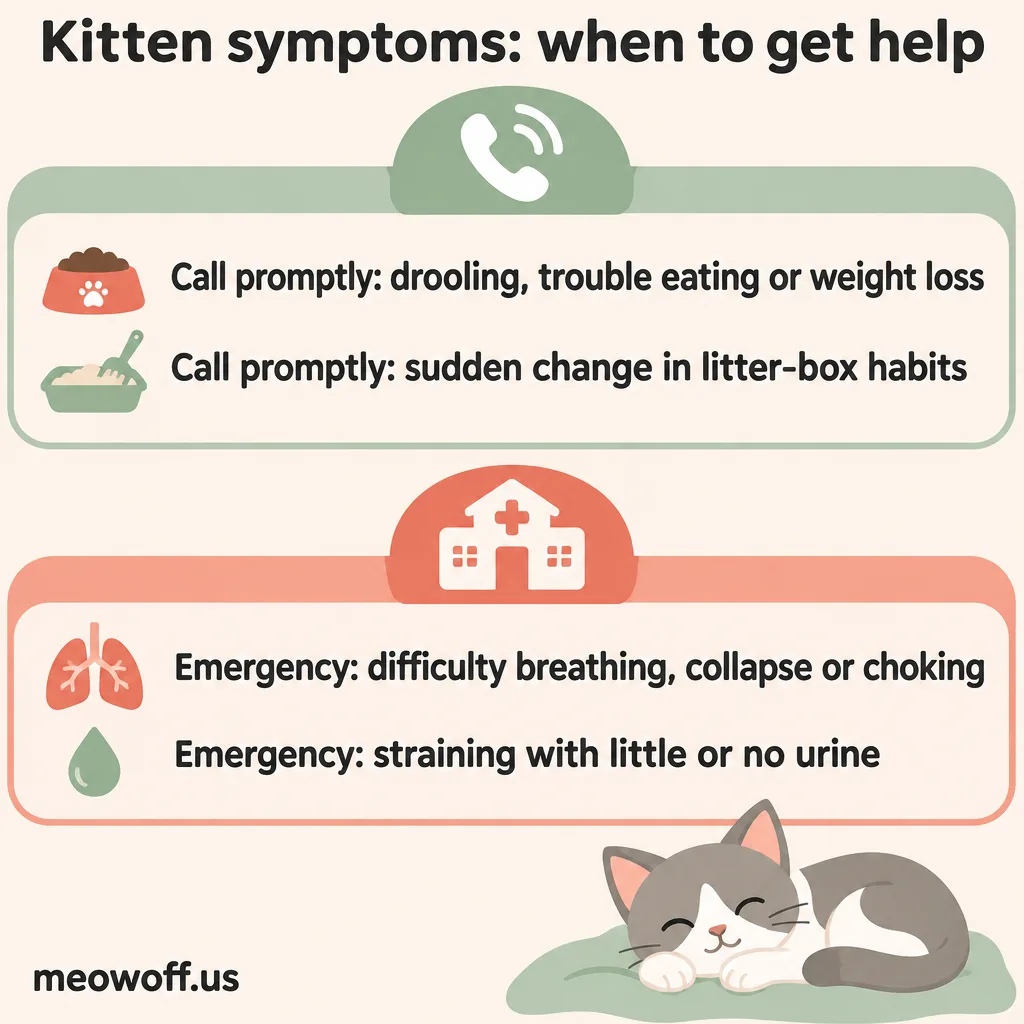
- Call promptly: Drooling, trouble eating, weight loss, poor growth, a sudden increase in hiding, or a change in litter-box habits.
- Seek emergency care: Difficulty breathing, collapse, unresponsiveness, choking, severe weakness, or straining to urinate with little or no urine.
- Call an emergency clinic immediately: Suspected swallowing of string, a small object, medication or another potentially toxic substance. Follow the clinic’s instructions and do not induce vomiting unless directed by a veterinarian.
When you call, describe your kitten’s age, symptoms, when they began, food and water intake, and recent litter-box use. Bring medication packaging or a sample of a suspected substance if the clinic asks, along with the kitten’s veterinary records.
Questions about your kitten’s next months at home? Talk to MeoWoff
We can help you prepare for a kitten’s arrival and offer guidance for the first 48 hours and first weeks at home. For illness or urgent symptoms, contact your veterinarian or an emergency clinic.
Call (773) 917-0073 or send us a message to talk with our team.