
Angry Maine Coon faces are often just serious-looking faces: a cat’s natural features do not, by themselves, tell you how it feels. A square muzzle, facial proportions and long fur can create a stern expression even when the cat is comfortable and relaxed.
To understand your cat’s mood, look beyond its face to its ears, body, tail, behavior and surroundings. A sudden change in expression or behavior deserves more attention than a naturally grumpy-looking photograph.
Why do Maine Coons look angry?
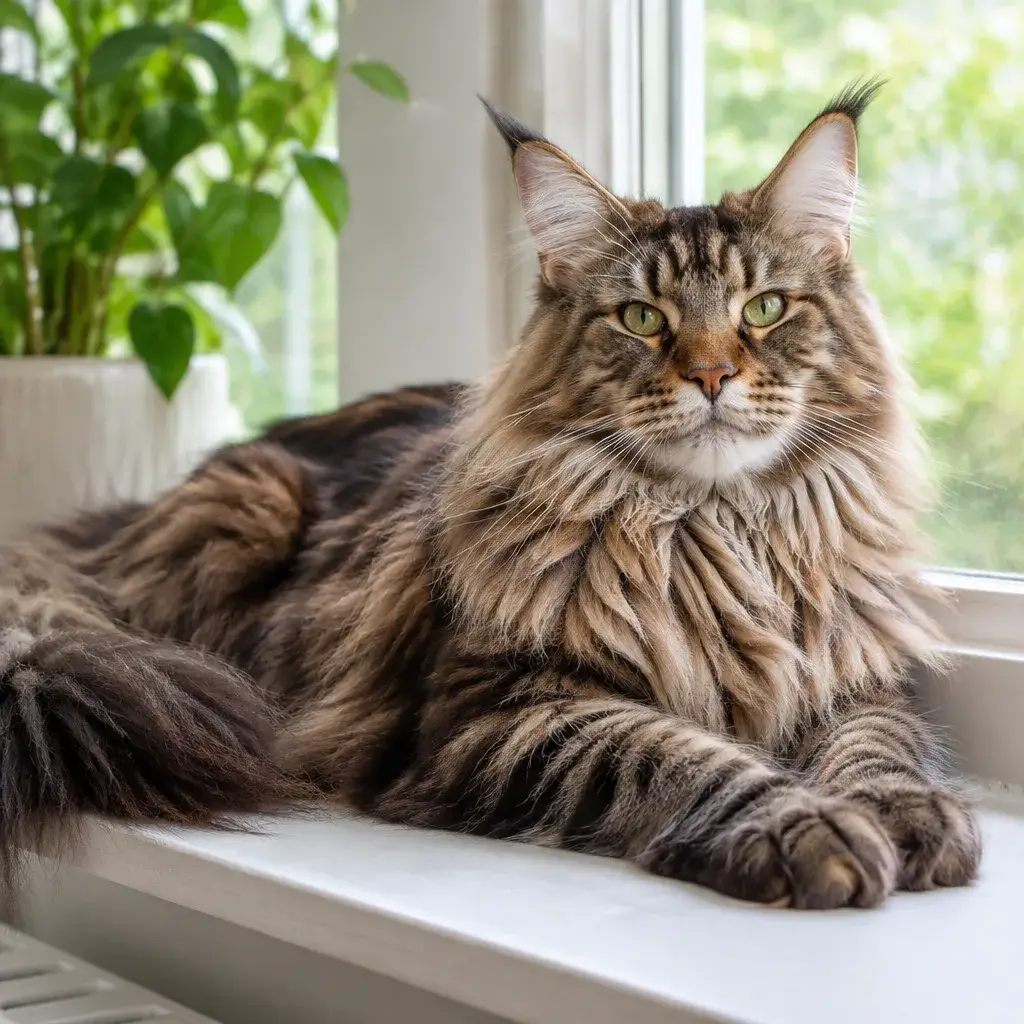
Maine Coons can look angry because their strong muzzle and facial proportions give some individuals a particularly serious expression. Long fur and contrasting markings can add to the impression, but they do not mean the cat is upset.
People also interpret cat faces through a human lens. A look that reminds us of a frown may simply be the cat’s normal appearance, especially in a still photograph that cannot show its movement or the situation around it.
If you are considering Maine Coon cats for sale, ask about each kitten’s behavior and care rather than choosing by expression alone. A kitten with a stern face can be curious and comfortable around people, while a sweet-looking kitten may need more time and space.
What makes a Maine Coon cat face look serious?
A Maine Coon cat face often looks serious because of its square muzzle, prominent cheekbones and the way its long fur frames its features. The exact look varies from cat to cat; a strong-looking face is not a reliable measure of temperament.
CFA and TICA breed descriptions include a square muzzle among the Maine Coon’s features, although individual cats do not all look alike. Explore more about the Maine Coon face and the variation you may notice between cats.

Why do Maine Coons look like lions?
Maine Coons can resemble lions because their longer neck fur creates a ruff around a broad-looking face. They are domestic cats, not lions, and the resemblance is a matter of appearance.
Ear tufts, a substantial body and a full coat may add to that impression. Ruff and coat fullness vary between individuals, and a growing kitten may not have the same finished look as an adult.
Coat pattern can influence what you see, too. For example, the dark lines on a tabby’s forehead may make its expression look more dramatic, but those markings stay in place whether the cat is sleepy, playful or startled.
Does a mean-looking Maine Coon have a mean personality?
No. A mean-looking Maine Coon may be friendly, reserved, playful or cautious; you cannot predict its personality from a face or photo. Many Maine Coons are sociable, but every cat has its own preferences and experiences.
When meeting a kitten, watch how it responds to gentle interaction and whether it recovers after an ordinary surprise, without forcing contact. For a closer look at typical social behavior, see Are Maine Coons friendly?
Why do some cats look angry when they are relaxed?
Some cats look angry when relaxed because their facial structure and markings are relatively fixed, while their posture and behavior change with their mood. A square muzzle or dark forehead lines can look like a frown even when the rest of the cat is at ease.
Lighting, camera angle and the moment a photo captures can change the impression. A cat resting with its eyes partly closed might appear to be glaring, for example, even though its body is loose and it has chosen a comfortable place to nap.
Compare that appearance with the cat’s usual behavior and surroundings. Is it resting in a familiar spot, or is it cornered by a noisy visitor? Is its body loose, or has it become rigid? The answers tell you more than a single facial feature.
Squinting is different from simply having a naturally serious face, particularly if it is new or affects one eye. Call your veterinarian if you notice squinting or discharge; an injured eye needs prompt veterinary care, and severe injury or an eye held shut warrants emergency care.
How can you tell if your cat is actually upset?
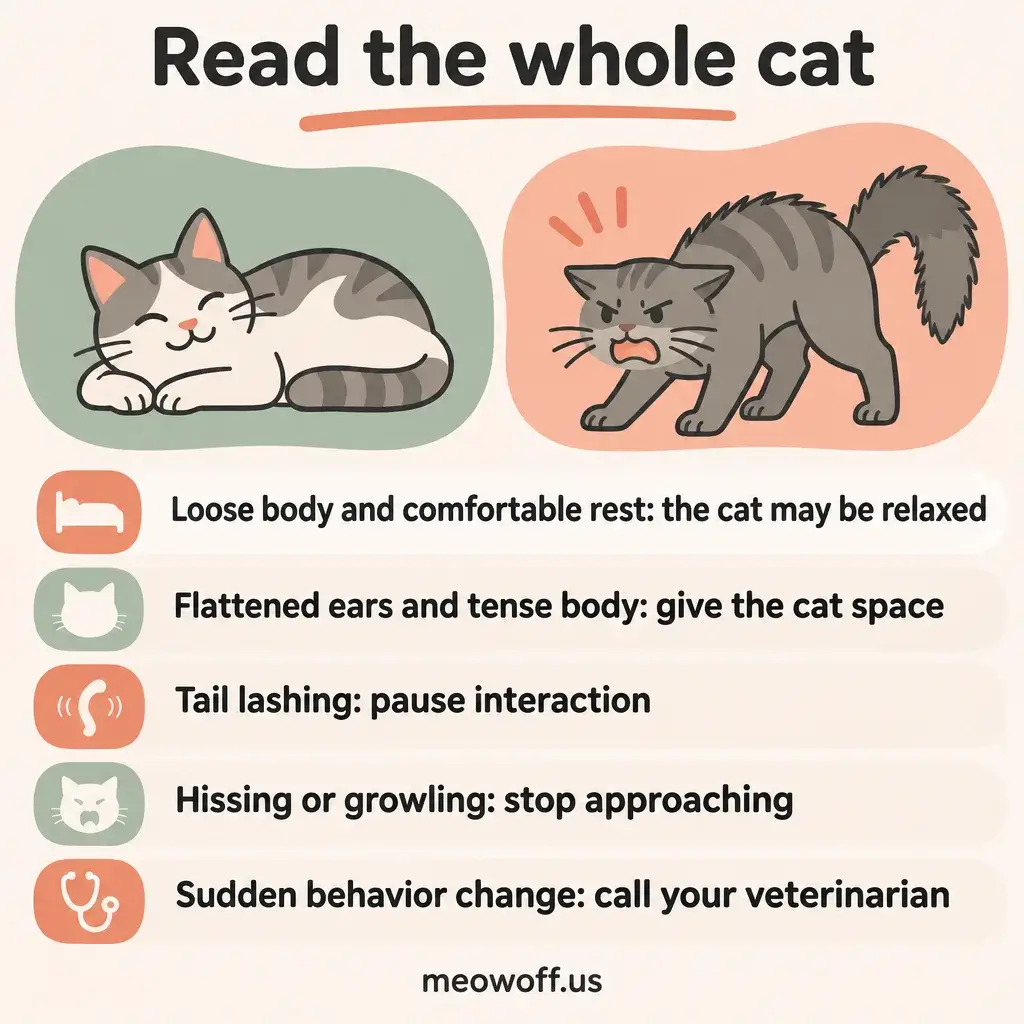
An upset cat usually shows a combination of changing body-language signals, such as a tense posture, flattened ears, tail lashing, growling or hissing. Read those signals together, in context, and compare them with what is normal for your cat.
| What you notice | What it may mean | What to do |
|---|---|---|
| Loose body, comfortable resting position, normal activity | The cat may be relaxed. | Let it rest and choose whether to interact. |
| Ears turned back or flattened, tense body, tail lashing | The cat may be uncomfortable, fearful or overstimulated. | Pause interaction and give it space. |
| Hissing, growling or a defensive posture | The cat is signaling that it wants distance. | Stop approaching and provide an exit. |
| Sudden behavior change, hiding or sensitivity to touch | Stress or a medical problem, including pain, is possible. | Call your veterinarian for advice. |
No single signal is a diagnosis. A moving tail can mean different things in different situations, and a cat may be alert without being angry. Look for several signs at once and ask what happened just before the behavior started.
For example, a cat that was calmly accepting a few strokes may begin lashing its tail and turn its head toward your hand. Stop petting and let it move away; continuing to touch it may escalate the interaction. A cat that approaches later can choose whether it wants more contact.
A serious expression does not prove aggression, and hissing does not automatically make a cat aggressive. It is a warning to respect. If you want to understand the distinction further, read Are Maine Coon cats aggressive?
Watch for a change from the cat’s usual routine, too: a normally social cat that suddenly hides, avoids touch, eats less or behaves differently may be uncomfortable or ill. Call your veterinarian about a sudden or persistent change. If your cat has trouble breathing, collapses, cannot urinate or has a serious injury, seek emergency veterinary care.

What should you do when your cat seems angry?
Give your cat space, stop the interaction and look for a possible stressor rather than forcing handling. Call your veterinarian for a sudden or persistent behavior change, apparent pain, squinting or eye discharge; an injured eye needs prompt care.
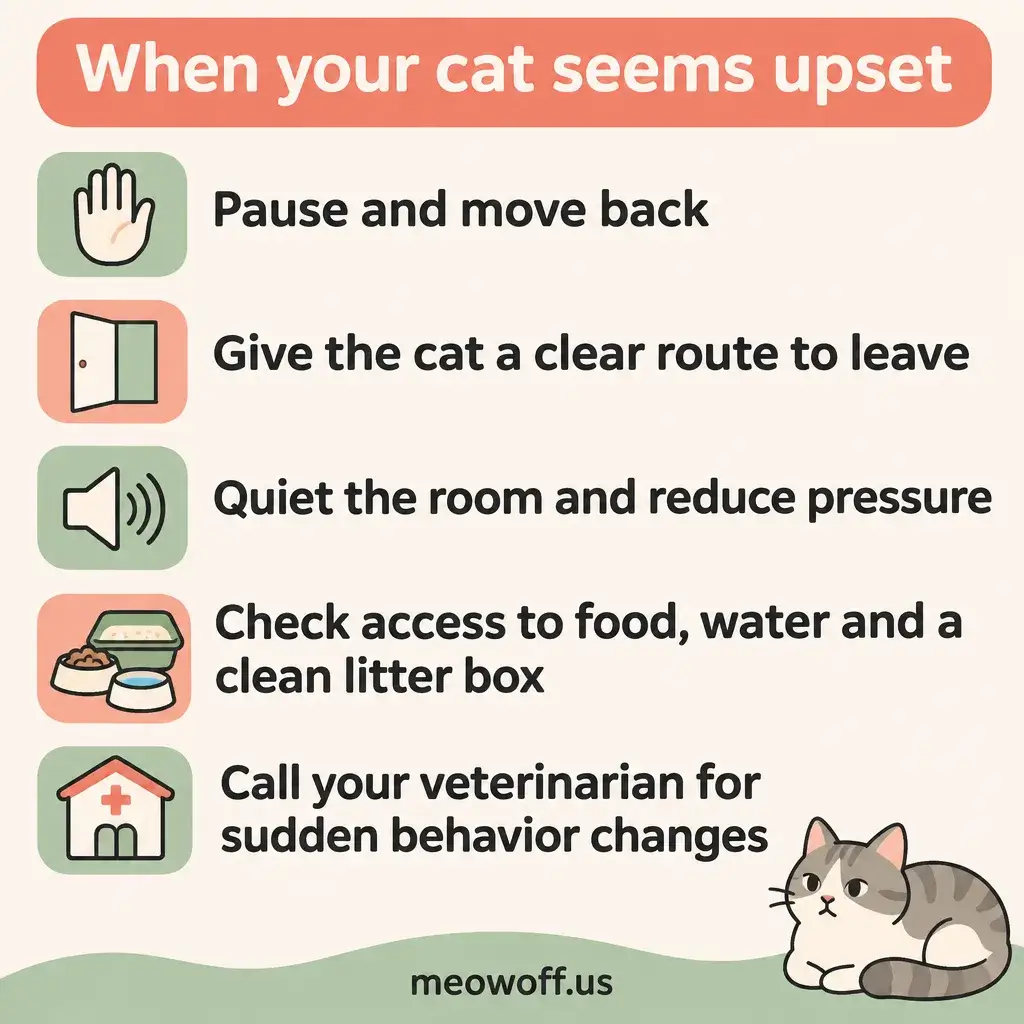
These steps help you respond without making the situation more frightening:
- Pause and move back. Keep your hands away from the cat’s face and give it a clear route to leave. Do not corner, chase or punish it for hissing.
- Reduce the pressure. Quiet the room when possible, move children or other pets away, and let the cat settle in a safe hiding place.
- Consider what changed. A visitor, unfamiliar animal, loud noise or unwanted touch may be relevant. Note when the behavior occurs and what happens just before it.
- Check the basics without forcing contact. Make sure the cat can reach food, water and a clean litter box without passing the suspected stressor.
- Ask for help if needed. Tell your veterinarian about changes in appetite, litter-box use, movement or tolerance of touch, as well as any eye symptoms.
For example, if your cat hisses when a guest reaches for it, ask the guest to sit quietly and let the cat decide whether to approach. If the same cat suddenly hisses when you touch a spot it previously tolerated, stop touching it and call your veterinarian rather than assuming it is misbehaving.
Seek emergency care if an eye is severely injured or held shut, or if the cat has difficulty breathing, collapses, cannot urinate or has a serious injury. Do not put human eye drops or other medication in the eye unless your veterinarian directs you to do so.
For ongoing patterns, a veterinary assessment can help rule out medical causes before you work on behavior. Our guide to Maine Coon behavior problems explains common concerns, and Maine Coon cat training covers ways to encourage desirable behavior without punishment.
For a new arrival, give the kitten a quiet starting space and introduce household activity gradually. Our kitten care first-week guide can help you plan that transition.
When choosing a kitten, my advice is to put health, genetics and temperament ahead of an exaggerated appearance. Ask how the kitten behaves during ordinary handling, what care it has received and what records will be shared. A cautious kitten may need time to settle, so look at its responses over an interaction rather than making a judgment from one moment.
At MeoWoff, kittens go home at 12–16 weeks after socialization and age-appropriate vaccines; they are microchipped, and their vet records are shared with the family. We also provide guidance for the first 48 hours and first weeks at home. Families researching Maine Coon cat breeders in Connecticut can ask us about delivery as well as a kitten’s individual temperament.
Questions about Maine Coon expressions? Talk to MeoWoff
We can help you discuss a Maine Coon kitten’s temperament and prepare for its first weeks at home. If your current cat has a sudden change in behavior or signs of pain, contact your veterinarian.
Call (773) 917-0073 or send us a message to talk with our team.