
What Is Giardia?
Giardia is a tiny single-celled parasite that lives in the intestines. It’s not a worm, not a virus, and not a bacteria — it’s a protozoan that spreads through contaminated water, soil, and surfaces.
Its full scientific name is Giardia duodenalis (also called Giardia intestinalis). It’s one of the most common intestinal parasites found in cats worldwide, with a global average prevalence of approximately 12% across all cat populations.1
How it works
The parasite exists in two forms. The trophozoite is the active form that lives and feeds inside the cat’s gut. The cyst is the armoured, dormant shell that gets passed in feces — it’s microscopic, immediately infectious, and incredibly tough to destroy.6
How Do Cats Get Giardia?
This is the most misunderstood part. Giardia is an environmental parasite — it’s everywhere in the outside world. A responsible breeder cannot fully prevent it, any more than you can stop a child from ever touching a doorknob.
Water
Giardia cysts survive for up to 2–3 months in cold water and can resist standard chlorine levels in tap water. Puddles, shared bowls, and garden ponds are all potential sources.5
Soil & outdoor surfaces
In cool temperatures (4°C), cysts survive in soil for at least 49 days with a 90% survival rate. This means your garden, any park, or any outdoor area is a potential source.5
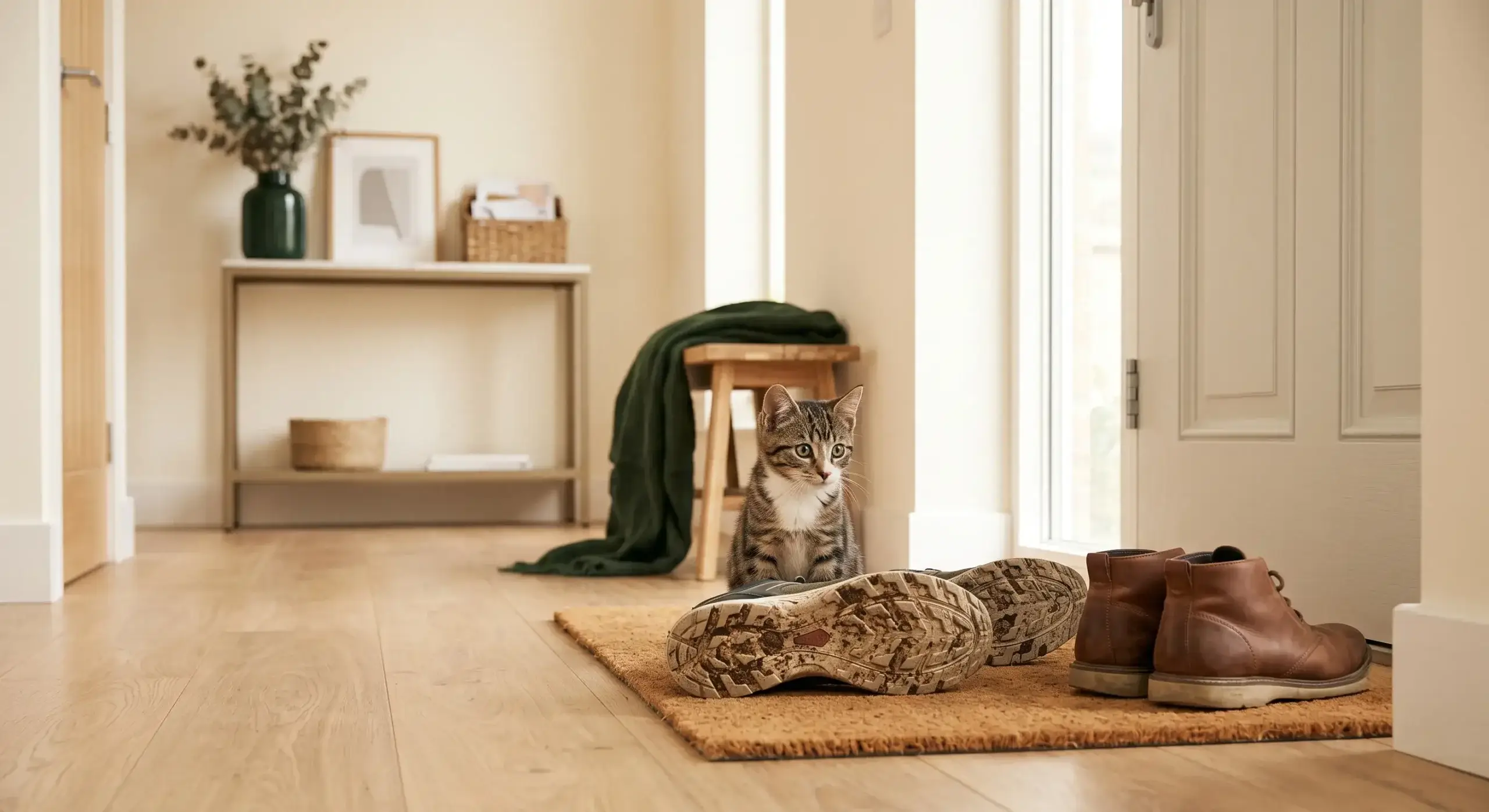
Shoes and clothing brought indoors
Cysts stick to footwear, clothing, and cleaning equipment and can be carried inside even to cats who never go outdoors. This is a documented, well-established transmission route.9
Grooming behaviour
Cats are meticulous self-groomers. If cysts land on their coat or paws during litter use, they swallow them during routine grooming — and can re-infect themselves even after a full treatment course if the litter box isn't cleaned daily.6
Cattery and multi-cat environments
Shared litter trays and close contact between animals amplify spread dramatically. Cats in shelters show a prevalence of 16.8% vs 11.3% in owned cats — the environment, not neglect, drives this difference.3

⚠️ Outdoor access risk
A global meta-analysis found that cats with outdoor access are 2.77 times more likely to carry internal parasites than strictly indoor cats. After your kitten leaves the breeder, every outdoor exposure — including your own shoes — is a new potential source.7
🫶 Yes — you yourself may have brought it in. And that’s okay.
Even if your kitten never steps outside, you walk outside every day. Giardia cysts attach to shoe soles, trouser hems, and hands — and survive for weeks on surfaces indoors. A single walk through a park, a visit to another pet owner, or touching a contaminated surface before handling your cat is enough.9
This is not anyone’s fault. It is simply how this parasite works. Don’t panic — Giardia is one of the most common and most treatable parasites in cats. A short course of medication and daily litter hygiene is all it takes to resolve it completely.
"Because the prepatent period of Giardia in cats ranges from 5 to 16 days, a cat can acquire the parasite and begin heavily contaminating the environment long before any clinical signs of diarrhea appear."
Saleh, 2021, Today's Veterinary Practice6
Do Infected Cats Actually Get Sick?
Here’s what most people don’t realise: the majority of Giardia-positive cats are perfectly healthy. A positive test result is not the same as being ill.
Most cats show no symptoms at all
In a large-scale urban study of 1,609 feline fecal samples (Moscow, 2018–2022), 24.4% of cats actively shedding Giardia had completely normal stool and zero signs of gastrointestinal illness. A separate study confirmed that in 28.9% of feline Giardia cases, no stool changes were observed at all.4
When symptoms do appear
If a cat does develop symptoms, they are typically mild digestive issues. Here are the most documented signs:4

💡 Why kittens are more vulnerable
Kittens have developing immune systems, so they’re more susceptible than adults. Age-related immunity — specifically better secretory IgA production in the gut — is why adult cats tend to clear the parasite naturally.8 Additionally, the stress of moving to a new home is a well-documented trigger for symptoms in an otherwise stable, asymptomatic carrier.2
A positive PCR test ≠ a sick cat
Modern PCR fecal tests are very sensitive — so sensitive that they can detect DNA from dead, non-viable Giardia. Both CAPC and ESCCAP explicitly advise against treating clinically healthy, asymptomatic cats based on a positive PCR alone, as the infection is often transient and unnecessary treatment can cause microbiome disruption.210
How Is It Treated?
Giardia is straightforward to treat. Two medications are used by veterinarians worldwide, both safe and well-studied.
⚠️ Why treatment sometimes “fails”
Treatment failures are almost never due to drug resistance. They happen because the cat re-infects itself from the litter box or its own fur. Medication without simultaneous environmental cleaning is ineffective.2

How to Clean Your Home During Treatment
This is the most important part of treatment. Follow these steps exactly to prevent your cat from re-infecting itself.
Clean the litter box every single day
Remove feces and soiled litter daily for the entire duration of treatment (and 1 week after). Cysts are shed continuously and your cat re-ingests them during grooming if they are left in the box. This single step is the most critical.2
Do this daily, every day
Wash all bedding and fabric at 60°C (140°F) or above
Giardia cysts are killed reliably by heat above 54°C within 10 minutes. Wash all blankets, cat beds, and fabric toys on a hot cycle. Cold or warm washes do not destroy the cysts.5
Hot wash — not warm
Use the right disinfectant on hard surfaces
Standard bleach solutions and most household sprays have very limited efficacy against Giardia cysts. Use quaternary ammonium compounds (e.g. Kennelsol, Roccal) or potassium peroxymonosulfate (e.g. Virkon-S, Trifectant) on floors, litter box, and surfaces.2
Not regular bleach
Let treated surfaces dry completely for 48 hours
Giardia cysts are highly susceptible to drying out. After disinfecting, ESCCAP recommends allowing all surfaces to dry completely for at least 48 hours before reintroducing your cat.2
48 hours drying time
Bathe your cat (if possible) mid-treatment
Cysts cling to your cat’s coat, especially around the hindquarters. Bathing once mid-way through the treatment course removes cysts from the fur and significantly reduces the chance of reinfection via grooming.2
Follow-up fecal test 24–48 hours after treatment ends
CAPC recommends a follow-up test exactly 24 to 48 hours after the final dose. Testing too late makes it impossible to distinguish genuine treatment failure from rapid reinfection, given the parasite’s short 5–16 day prepatent period.13
24–48 hrs post-treatment
Can I Catch Giardia From My Cat?
This is a very common question. The short answer from every major veterinary authority: almost certainly not.
Risk of cat-to-human transmission
ESCCAP · CAPC · CDC · WSAVA · AVMA — all authorities agree
Why the risk is so low: Assemblage F
Giardia is not a single species but a group of eight genetically distinct strains called assemblages (A–H). They look identical under a microscope but are very different genetically — and critically, they each prefer different hosts.6
Cats: Assemblage F
Humans: Assemblages A & B
✓ Official consensus
The CDC, ESCCAP, CAPC, WSAVA, and AVMA all classify the risk of cat-to-human Giardia transmission as extremely low in households with healthy adults. Basic hygiene — washing hands after handling the litter box — is sufficient protection.14
Frequently Asked Questions
Answers grounded in peer-reviewed evidence and official veterinary guidelines.
Does a positive Giardia test mean the breeder sold me a sick kitten?
No. Giardia is a parasite of the environment, not a genetic disease or a sign of poor care. Studies show that 18.7% of cats in pedigree catteries carry Giardia even when breeders actively treat for it — because cysts enter through water, soil, and even the shoes of visitors.14 After a kitten moves to a new home, reinfection can occur through the new environment’s water, fomites, or outdoor contact. A positive test after rehoming does not trace back to the breeder.
Why did my kitten get sick right after I brought them home if the breeder treated them?
This is completely normal and has a clear biological explanation. The stress of moving — weaning, travel, new smells, new people — suppresses the immune system. A kitten can be a stable, asymptomatic carrier at the breeder and then develop diarrhea within days of arriving at a new home, simply because stress lowers the immune threshold. ESCCAP explicitly lists relocation stress as a primary trigger for clinical giardiasis in otherwise stable carriers.2 This is not the breeder’s fault.
Wasn’t the kitten dewormed? Why didn’t that prevent this?
Standard deworming medications — such as pyrantel pamoate and praziquantel — target worms, including roundworms and hookworms, as well as tapeworms. They have zero effect on Giardia, which is a protozoan, not a worm. This is a very common misunderstanding. A kitten can be perfectly “dewormed” against nematodes and cestodes and still carry Giardia, because they require completely different medication, such as fenbendazole or metronidazole.12
My cat looks and acts completely healthy. Does Giardia still need to be treated?
This is a question for your vet — and there is genuine clinical debate. Both CAPC and ESCCAP advise against treating asymptomatic, clinically healthy cats on a positive PCR alone, because the infection is often transient and unnecessary antibiotic use contributes to microbiome disruption and antimicrobial resistance.10 If your cat is active, eating well, and has normal stool, raise this with your vet before automatically treating.
Is Giardia a warranty/guarantee case when buying a kitten?
No. Giardia does not qualify as a congenital disease, a heritable condition, or an acute infectious disease attributable to a single source. It is a ubiquitous environmental parasite with documented prevalence in the vast majority of catteries globally. Itoh et al., 2016 found it in almost every cattery tested.14 Holding a breeder responsible for Giardia is comparable to holding a car manufacturer responsible for a flat tyre — the road environment, not the product, is the source. Treatment is simple, inexpensive, and resolves in 4–7 days.
How do I stop my cat from getting re-infected after treatment?
Daily litter box cleaning is the single most important step. Cysts are shed into the litter, stick to paws and fur, and get swallowed during grooming — restarting the cycle even while medication is being given. Use a vet-approved disinfectant, not bleach, on hard surfaces, wash fabric items at 60°C+, and allow surfaces to dry completely for 48 hours after disinfection. Cysts cannot survive drying out.2
References & Authoritative Guidelines
All claims in this article are supported by peer-reviewed studies or official guidelines from veterinary parasitology authorities.
- Bouzid, M., Halai, K., Kao, G., & Hunter, P. R. (2015). The prevalence of Giardia infection in dogs and cats, a systematic review and meta-analysis of prevalence studies from worldwide.Parasitology Research, 114(8), 2805–2815.
- European Scientific Counsel Companion Animal Parasites (ESCCAP). (2025).Guideline 06: Control of Intestinal Protozoa in Dogs and Cats(Edition 3). ESCCAP Secretariat. www.esccap.org/guidelines/gl6/
- Štrkolcová, G., et al. (2025). Prevalence of intestinal parasites in owned and shelter cats in Slovakia.Parasitology Research.
- Esaulova, N. V., et al. (2024). Prevalence of Giardia duodenalis in dogs and cats: Age-related predisposition, symptomatic, and asymptomatic cyst shedding.Veterinary World, 17(2), 379–383.
- Centers for Disease Control and Prevention (CDC) / Environmental Protection Agency (EPA). (2015).Giardia Drinking Water Fact Sheet. cdc.gov/giardia/about/about-giardia-and-pets.html
- Saleh, M. N. (2021). Feline Giardia: Transmission, Diagnosis, and Treatment.Today’s Veterinary Practice, May/June 2021, 28–33.
- Chalkowski, K., Wilson, A. E., Lepczyk, C. A., & Zohdy, S. (2019). Who let the cats out? A global meta-analysis on risk of parasitic infection in indoor versus outdoor domestic cats.Proceedings of the Royal Society B: Biological Sciences, 286(1901), 20190109.
- Robertson, L. J., et al. (2010). Giardiasis — why do the symptoms sometimes never stop?Trends in Parasitology, 26(2), 75–82.
- Abbaszadegan, M., et al. (2014). Survival of Cryptosporidium and Giardia (oo)cysts on environmental surfaces.International Journal of Environmental Research and Public Health, 11(7).
- Unterer, S., et al. (2019). Interpretation of positive fecal PCR results in gastrointestinal disease.Journal of Veterinary Internal Medicine.
- Villeneuve, A., et al. (2022). Efficacy of fenbendazole for the treatment of giardiosis in domestic settings.Parasite.
- World Small Animal Veterinary Association (WSAVA). (2018).How I Treat Giardiasis(Congress Proceedings, Susan E. Little). wsava.org/global-guidelines/
- Companion Animal Parasite Council (CAPC). (2025).CAPC Guidelines: Giardia. capcvet.org/guidelines/giardia/
- Itoh, N., et al. (2016). Prevalence of intestinal parasites in breeding cattery cats in Japan.Journal of Feline Medicine and Surgery, 18(10), 834–837.
- Ponce-Macotela, M., et al. (2023). Occurrence of Giardia duodenalis in cats from Queretaro and the risk to public health.Animals (MDPI), 13(6), 1098.
- American Veterinary Medical Association (AVMA). (2025). Zoonotic Diseases and Pets. avma.org/resources-tools/one-health/zoonotic-diseases-and-pets